
Grok Imagine vs Seedance 2.0: Speed, Cost, and Motion Compared (2026)
Compare Grok Imagine Video 1.5 and ByteDance Seedance 2.0 for AI video. Official speed, native audio, physics claims, API cost, and which model to run first.
Grok Imagine Video 1.5 and Seedance 2.0 are the two short-clip models creators actually argue about in 2026. Affiliate roundups still say one of them lacks audio, or that Grok is capped at 720p. Official docs contradict both claims.
This is a research comparison, not a 50-clip studio benchmark. Specs come from xAI video generation docs, the Grok Imagine Video 1.5 announcement (16 June 2026), the Seedance 2.0 launch (12 February 2026), The Verge, xAI pricing, BytePlus LAS billing (updated 31 August 2026), and a 4 September 2026 snapshot of the Artificial Analysis image-to-video leaderboard. Credit costs labeled as workspace rates are taken from this site's published pricing table for the same date.
If you already know you need Kling or Veo instead, use the Grok Imagine vs Kling 3.0 vs Veo 3.1 comparison. For Grok Imagine Video 1.5 inputs and duration controls, see the Grok Imagine Video 1.5 generator.
Key Takeaways
- Grok Imagine Video 1.5 and Seedance 2.0 both generate native audio. The useful split is speed and cost versus multimodal control and hard motion, not silent versus soundtrack.
- xAI says Imagine Video 1.5 Fast produces a 6-second 720p clip in about 25 seconds. The Imagine API lists
grok-imagine-video-1.5at $0.080 per second.- ByteDance positions Seedance 2.0 for complex motion, up to nine image references, three video clips, three audio clips, and dual-channel sound. That physics edge is a vendor claim with creator-test support, not an independent lab bake-off.
- On the 4 September 2026 Artificial Analysis image-to-video board, Seedance 2.0 720p led Grok 1.5 with audio (Elo 1190 vs 1109). Without audio the gap shrank to 1338 vs 1328.
- Run Grok first when you have one still and need cheap drafts. Run Seedance 2.0 when the brief needs references, stereo sound design, or harder physical action.
Quick comparison table
| Category | Grok Imagine Video 1.5 | Seedance 2.0 |
|---|---|---|
| Best for | Fast image-to-video drafts from one still | Multimodal references and harder motion |
| Native audio | Yes, on by default | Yes, dual-channel / multi-track |
| Official speed claim | ~25s for 6s 720p (Fast) | Fast/Mini SKUs exist; no official wall-clock |
| Native duration | 1 to 15 seconds | 4 to 15 seconds (2.5 later adds 30s) |
| Resolution | 480p / 720p / 1080p T2V and I2V; R2V max 720p | 480p and 720p native; 1080p and 4K billed as conversion factors on BytePlus |
| References | Start-frame still; preset voices; custom audio for partners | Up to 9 images, 3 videos, 3 audios |
| API 10s at 720p | $0.80 ($0.080/s) | $3.03 Enhanced, about $1.51 Mini |
| Consumer catch | Shared weekly usage pool; 720p can fall back to 480p; watermark stays | Dreamina / Doubao / BytePlus access paths |
| Our verdict | Winner for volume I2V | Winner for control and motion ceiling |
Which model is actually faster?
Grok Imagine Video 1.5 wins on the only official wall-clock number in this comparison. xAI says Imagine Video 1.5 Fast produces 6-second, 720p videos in about 25 seconds, down from 40+ seconds on the previous Grok model (Grok Imagine Video 1.5, 16 June 2026).
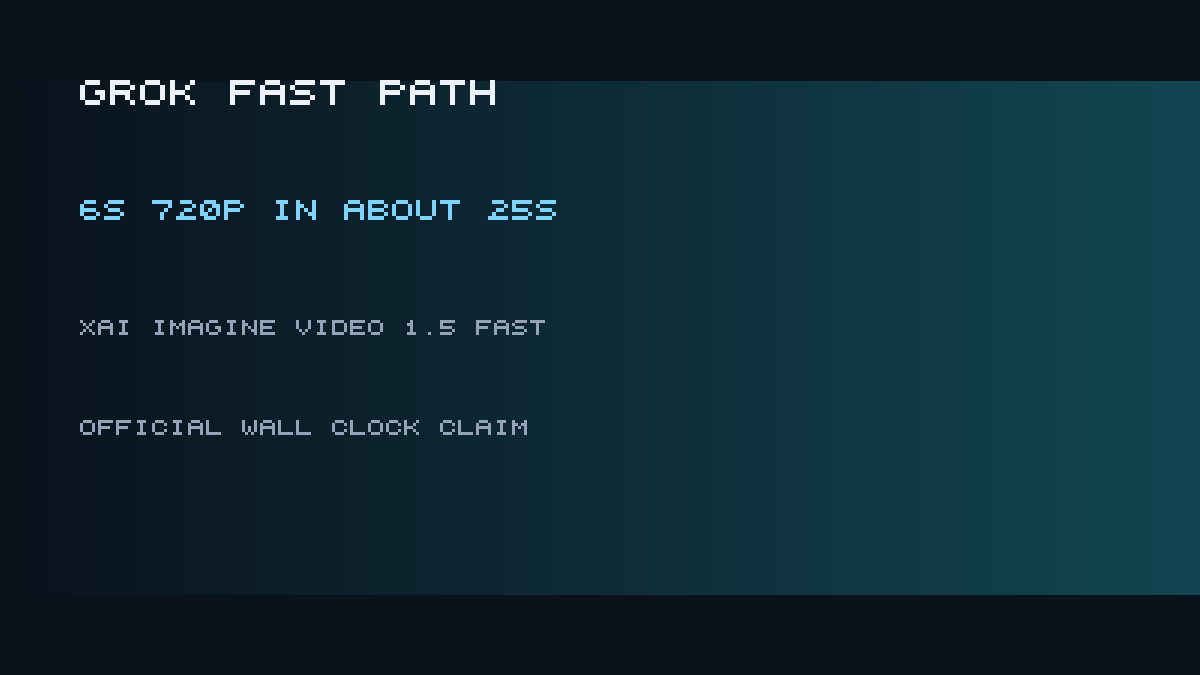
Seedance 2.0 ships Fast and Mini SKUs on BytePlus LAS, so ByteDance clearly sells a cheaper, quicker tier. Those pages do not publish a seconds-to-complete figure comparable to xAI's 25-second claim. Creator tests often call Grok the faster box. Treat that as anecdote unless the tester published a protocol.
Nuance: Fast is not the same as "always done in 25 seconds." Queue time, resolution, audio, and the host you use all move the clock. The documented point is that Grok published a Fast latency target and Seedance 2.0 did not.
Verdict: Grok Imagine Video 1.5 for iteration speed.
Creator-side timing shows up in public tests as well. Yaroflasher's Grok Imagine Video 1.5 vs Seedance 2.0 comparison is a useful watch for fight scenes, lip-sync, and on-screen text, even though it is not a lab protocol.
Do both models generate native audio?
Yes. Both models output native audio. Seedance 2.0 wins on documented sound design. Grok wins on "audio is on unless you turn it off."
xAI's video API says generated videos include an audio track by default, and generate_audio=False requests a silent clip (video generation). The 1.5 announcement adds that sound effects, ambience, and dialogue are generated in the same pass.
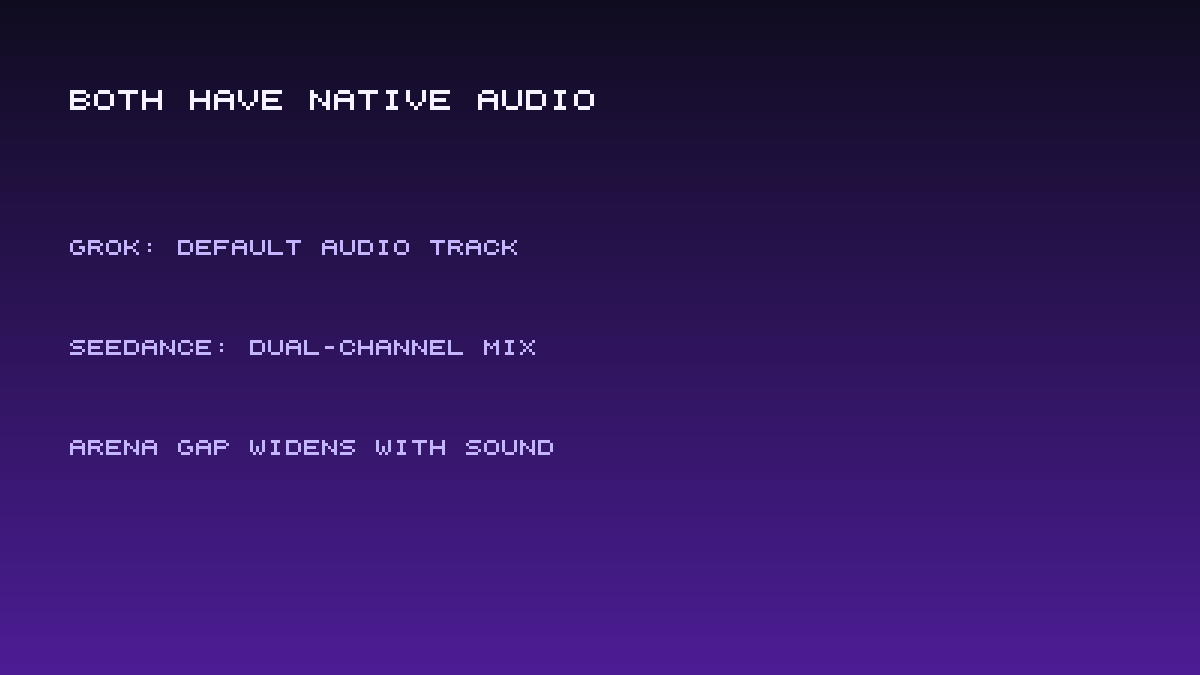
ByteDance describes Seedance 2.0 as a unified multimodal audio-video model with 15-second audio-video output and dual-channel stereo that can carry background music, ambient effects, and voiceover together (Seedance 2.0 launch). The Verge (12 February 2026) corroborated the multimodal input stack, including audio clips as references.
The live arena numbers match that story more closely than "Grok crushes Seedance on audio." On 4 September 2026, the Artificial Analysis image-to-video leaderboard showed Dreamina Seedance 2.0 720p at Elo 1190 with audio versus grok-imagine-video-1.5 at 1109. Without audio, Seedance was 1338 and Grok 1.5 was 1328. The board is a moving snapshot of blind votes, not a physics simulator. The pattern is still clear: Seedance's lead is larger when sound is in the vote.
Nuance: Affiliate posts that say Grok has no native audio are wrong. So is the inverse talking point that Grok dominates Seedance on sound. Creative AI Show said the same in a public test: Grok 1.5 improved, and it still did not beat Seedance on the audio side.
Verdict: Seedance 2.0 for soundtrack control. Grok 1.5 for default synced audio on a cheap I2V pass.
Which model handles complex physics and motion better?
Seedance 2.0 is the safer pick for hard physical action, with an honest caveat: ByteDance claimed the physics win, and creators often agree, but there is no independent Grok-versus-Seedance physics lab.
ByteDance says Seedance 2.0 improved physical accuracy and complex multi-subject motion, and it uses pair figure skating as the flagship demo: synchronized takeoffs, mid-air spins, and ice landings that "follow real-world physical laws" (Seedance 2.0 launch). The Verge reported that claim on launch day.
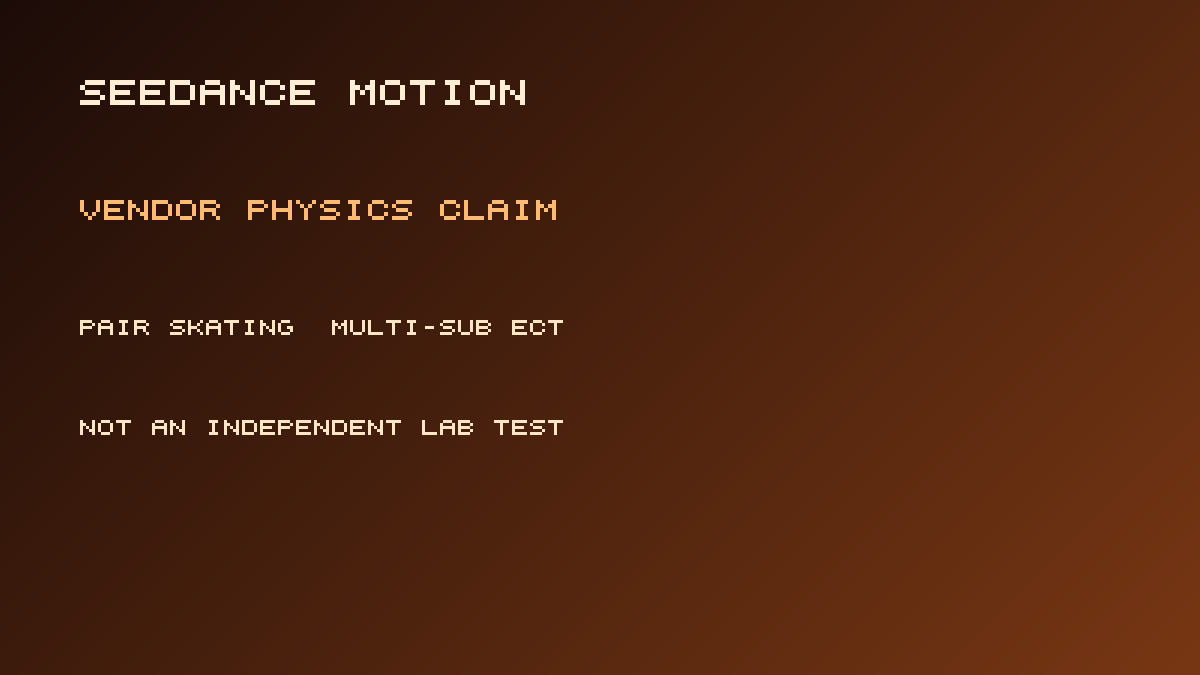
xAI also claims "better physics" for Imagine Video 1.5. That comparison is versus prior Grok, not versus Seedance (1.5 announcement). Stanford's 2026 AI Index physics-style video work is about Veo 3 zero-shot tests, not this head-to-head.
Public creator tests usually give Seedance the fight-scene and VFX vote, and Grok the in-scene text vote. Yaroflasher's comparison above is one example. That is useful direction, not a scoreboard.
Verdict: Seedance 2.0 when motion believability is the bottleneck. Grok 1.5 when the still already contains typography you need to keep.
Which model accepts more useful inputs?
Seedance 2.0 wins on reference count. Grok Imagine Video 1.5 wins on "one good frame is enough."
Seedance 2.0 accepts mixed text, image, video, and audio. Users can feed up to nine images, three video clips, and three audio clips plus instructions (launch; The Verge). That is the model to use when the brief is "keep this product, this face, this camera move, and this bed of sound."
Grok 1.5 is built around a start-frame still plus a motion prompt. Reference-to-video can carry preset voices through reference_audios; custom audio files are limited to trusted partners (video generation). Text-to-video on 1.5 still runs as text-to-image then image-to-video under the hood. You send one request. You do not get the intermediate frame back.
On this workspace, the image-to-video generator exposes Grok Imagine 1.5 as a one-image path at 480p or 720p, and Seedance 2.0 as a multi-reference path. Older Grok text-to-video remains the Grok route when you do not have a start frame yet.
Nuance: More references are not free quality. A messy nine-image stack will confuse Seedance as fast as a vague prompt will confuse Grok. Start with the smallest input that specifies identity, motion, and sound.
Verdict: Seedance 2.0 for multimodal control. Grok 1.5 for single-frame animation.
How do duration, resolution, and access limits compare?
Grok and Seedance 2.0 tie at 15 seconds native. Veo 3.1 is shorter. Seedance 2.5 is longer. Access limits are where the products diverge.
xAI documents 1 to 15 seconds, with 1080p on grok-imagine-video-1.5 for text-to-video and image-to-video. Reference-to-video is capped at 720p (video generation). On grok.com, 1080p video creation is a SuperGrok Plus ($100/month) differentiator versus SuperGrok ($30/month) (x.ai/pricing, retrieved 2026-09-04). Paid Grok usage is a shared weekly pool as of June 2026, 720p can fall back to 480p after a cap, and the Grok watermark cannot be removed (Grok FAQ).
Google Veo 3.1's native clip is 4, 6, or 8 seconds, with 8 seconds required for 1080p, 4K, and references (Gemini Veo). That is why Veo often loses "first draft length" even when it wins realism reviews.
Seedance 2.5 (31 July 2026) later raised the ByteDance ceiling to a 30-second one-take. This article compares 2.0, because that is the SKU still sitting on most vs-Grok SERPs.
If official Grok quotas are the actual blocker, read the Grok Imagine limit guide and the Grok Imagine alternatives after limits page before you switch models for the wrong reason.
Verdict: Tie on 15-second native length. Grok is easier to start. Seedance 2.0 (and 2.5) is the longer production path.
What does each model cost?
For a documented 10-second 720p API clip with no input video, Grok Imagine Video 1.5 costs $0.80 and Seedance 2.0 Enhanced costs $3.03.
xAI lists grok-imagine-video-1.5 at $0.080 per second with no resolution split on that table (xAI pricing, retrieved 2026-09-04). The older grok-imagine-video model is $0.050 per second.
BytePlus LAS bills Seedance 2.0 Enhanced at $0.303 per second times a resolution factor. For 720p with no input video the factor is 1.0, so 10 seconds is $3.03. Seedance 2.0 Mini uses $0.242 per second times a 720p factor of 0.625, about $1.51 for the same 10 seconds (BytePlus LAS billing, updated 31 August 2026).
Workspace credit costs are a different meter. On this site's 4 September 2026 table, a 6-second 720p Grok Imagine 1.5 clip is 110 credits, and a 6-second 720p Seedance 2.0 clip (no source video) is 620 credits. Those numbers are this workspace's credit formula, not xAI or ByteDance list prices. Check the on-screen cost before you generate. Grok Imagine pricing and credit packs explain plans and credit packs.
Hidden costs matter more than the sticker. grok.com spends a shared weekly pool across Chat, Imagine, Voice, and Build. Extra credits cost more per action than included plan usage (Grok FAQ). Seedance video inputs on BytePlus bill input duration plus output duration, so a 10-second source plus a 10-second result is not a 10-second invoice.
Verdict: Grok Imagine Video 1.5 for cost per draft. Seedance 2.0 when the extra references and motion are worth the multiplier.
Who should choose Grok Imagine, and who should choose Seedance 2.0?
If you have one still and need many drafts, choose Grok Imagine Video 1.5. If you have a stack of references and the motion has to land, choose Seedance 2.0.
Social and ad teams testing hooks: Choose Grok 1.5. The Fast clock and $0.080/s API rate (or the lower workspace credit count) let you throw away bad takes.
Filmmakers and product teams with identity constraints: Choose Seedance 2.0. Nine images, three videos, and three audios exist for a reason.
Anyone who hit a Grok weekly cap: Do not assume Seedance is the fix. Diagnose quota first, then switch models only when quality, not the weekly pool, is the problem.
Anyone comparing against Google Veo 3.1: Veo's native 8-second cap is the constraint. Grok and Seedance both give you 15 seconds before you chain extends. Keep Veo for the realism pass after the cut is decided, or open the best AI video editor comparison if the job is editing an existing clip rather than generating one.
IAB's 14 July 2026 digital video report found that nearly two in three buyers now use GenAI for digital video creative, up from about half in 2025 (IAB). Volume tools and control tools can both be rational in the same week. The mistake is paying Seedance prices for Grok jobs, or running Grok when the shot needs a reference stack.
After you know which job you are in, generate the same prompt on both models in the image-to-video workbench. That is the shortest way to see whether your still wants Grok speed or Seedance control.
Frequently asked questions
Is Grok Imagine better than Seedance 2.0?
Not as a single score. Grok Imagine Video 1.5 is better for fast, cheaper image-to-video drafts with default audio. Seedance 2.0 is better for multimodal references, dual-channel sound, and harder physical action. Pick the job, then pick the model.
Can I use Seedance 2.0 without Dreamina?
Yes. ByteDance launched Seedance 2.0 on Dreamina and Doubao (The Verge). API access also exists through BytePlus LAS. Independent workbenches, including this one, route Seedance 2.0 as a selectable model next to Grok.
Does Grok Imagine Video 1.5 do text-to-video?
Yes, on the xAI API. Text-to-video on 1.5 generates a first frame internally, then animates it. You still send one request (video generation). Some workbenches expose 1.5 as image-to-video only and keep older Grok Imagine for prompt-to-video. Check the model picker rather than assuming every host matches the API.
Why do some blogs say Grok has no native audio?
Those pages are stale or copying each other. xAI documents a default audio track and a generate_audio=False switch. Seedance 2.0 also generates native audio. The real audio question is mix quality and references, not presence.
Is Seedance 2.5 the model I should compare instead?
Compare 2.5 when you need a 30-second one-take. Keep 2.0 when you are ranking against Grok Imagine Video 1.5, because that is the pair most 2026 vs pages still use. Mention 2.5 as the ByteDance ceiling, then test the SKU you will actually buy.
Verdict
| Category | Winner |
|---|---|
| Speed | Grok Imagine Video 1.5 |
| Native audio presence | Tie |
| Soundtrack control | Seedance 2.0 |
| Complex motion / physics claims | Seedance 2.0 |
| Single-image I2V | Grok Imagine Video 1.5 |
| Multimodal references | Seedance 2.0 |
| API cost at 720p | Grok Imagine Video 1.5 |
| 15-second native length | Tie |
| Overall | Grok for drafts. Seedance 2.0 for the motion and reference pass. |
Choose Grok Imagine Video 1.5 when the still is ready and you need many takes before lunch. Choose Seedance 2.0 when the shot has to obey a reference stack, a stereo bed, or a physical stunt the still cannot imply. If the next click is a three-way with Kling and Veo, start from the comparison already linked in the introduction.
This independent Grok Imagine workspace is not affiliated with, endorsed by, or sponsored by xAI, Grok, ByteDance, Seedance, Google, or Veo.